26 Jun 2026
Adoption Trends of Artificial Intelligence Tools for Fraud Detection in Online Sports Wagering Systems Operating Under Strict Regulatory Frameworks

Online sports wagering platforms have expanded rapidly under frameworks that demand real-time oversight, and operators in jurisdictions with tight controls now integrate artificial intelligence to identify fraudulent patterns before they escalate. Systems analyze betting volumes, user behavior sequences, and transaction anomalies while staying aligned with licensing conditions that require documented audit trails.
Regulatory bodies across multiple regions have issued guidelines that encourage or require technology capable of flagging suspicious activity, and this pressure has accelerated deployment of machine learning models trained on historical fraud data sets. In June 2026 operators reported measurable reductions in chargeback rates after rolling out these tools in markets where compliance documentation must be submitted monthly.
Regulatory Drivers Behind AI Integration
Strict licensing regimes in places such as Ontario and the Netherlands require operators to demonstrate proactive fraud controls, and data from the Alcohol and Gaming Commission of Ontario shows that platforms using AI detection submitted fewer incident reports in the first quarter of 2026 compared with those relying solely on rule-based filters. These frameworks typically specify that detection algorithms must log decisions in formats accessible to auditors, which has pushed vendors to build explainable AI modules that satisfy review processes.
Operators also face cross-border obligations when serving players from multiple regulated territories, and this complexity favors centralized AI platforms that can apply jurisdiction-specific rules without manual intervention. Research published by the University of Nevada, Las Vegas International Gaming Institute indicates that companies operating under such layered requirements adopted anomaly detection models at nearly twice the rate of those in less prescriptive environments between 2024 and 2026.
Core AI Capabilities Deployed in Wagering Environments
Current implementations combine supervised learning for known fraud signatures with unsupervised clustering to surface novel schemes, and these dual approaches allow systems to adapt as betting markets evolve. Pattern recognition engines examine login geolocation sequences, stake sizing relative to account history, and correlation between live event timing and bet placement, while maintaining separation between player data and regulatory reporting streams.
Some platforms now embed graph neural networks that map relationships among accounts, payment methods, and device fingerprints, and this network view has proven effective at uncovering coordinated manipulation attempts across multiple users. Reports submitted to the Dutch Kansspelautoriteit in early 2026 highlighted cases where such graph analysis identified syndicate activity that traditional monitoring missed.
Measured Adoption Patterns Through Mid-2026
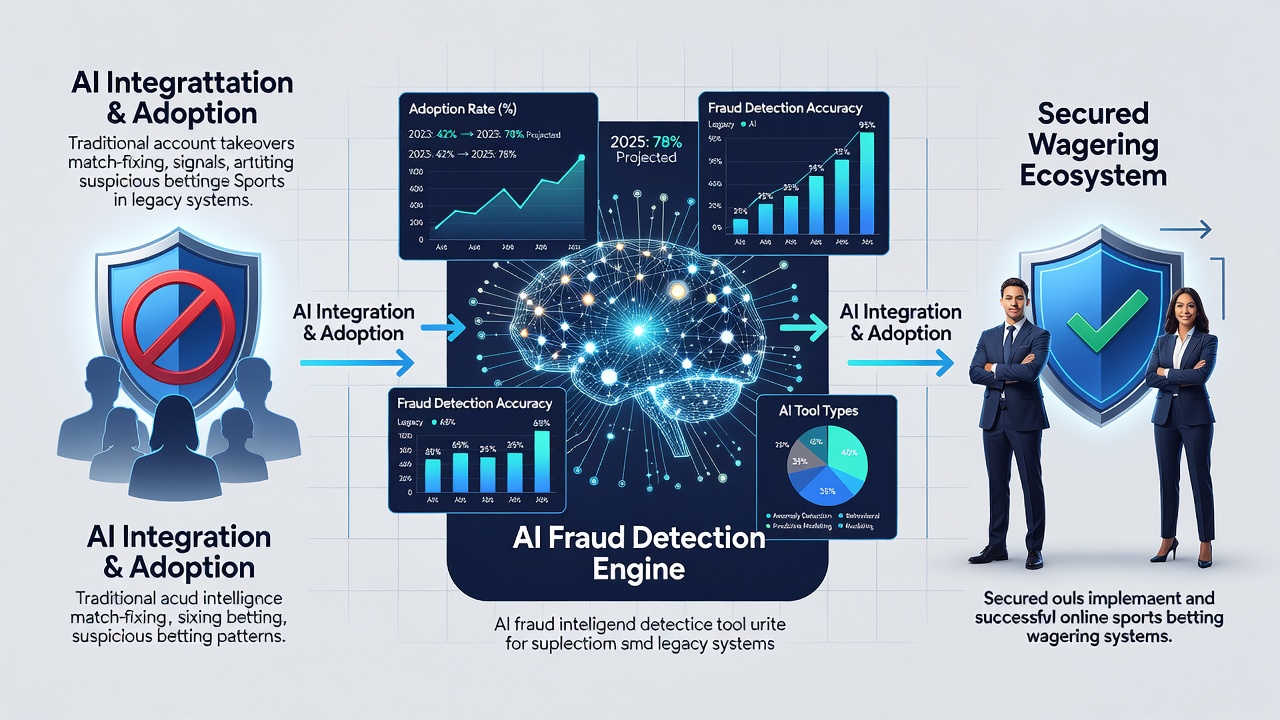
Industry surveys conducted by the European Gaming and Betting Association reveal that 68 percent of licensed sports wagering operators in participating member states had deployed at least one AI fraud module by June 2026, with higher uptake among those handling daily transaction volumes above a defined threshold. Smaller operators often begin with cloud-based solutions that scale according to regulatory reporting deadlines rather than building custom systems from scratch.
Adoption curves differ by regulatory maturity, and jurisdictions that updated their technical standards most recently show faster integration timelines. Data shared through the Canadian Gaming Association indicates that Ontario-licensed platforms reached 82 percent coverage of AI-assisted monitoring by the second quarter of 2026, while markets still finalizing detailed AI audit protocols lagged behind.
Implementation Challenges and Compliance Adjustments
Integrating AI tools into legacy wagering engines requires careful mapping of data fields to regulatory categories, and operators report extended testing periods to ensure false positive rates do not trigger unnecessary player account reviews. Training data must reflect the specific sports and bet types offered in each jurisdiction, which adds complexity when platforms expand offerings across borders.
Staff training programs have shifted accordingly, and compliance teams now include data scientists who interpret model outputs for regulatory submissions. One operator serving multiple European markets documented a six-month transition period during which parallel rule-based and AI systems ran simultaneously before full cutover.
Conclusion
Adoption of artificial intelligence for fraud detection continues to track the pace of regulatory specification updates, and platforms operating under the most detailed compliance regimes have moved furthest toward automated monitoring. Figures from oversight agencies show consistent year-over-year growth in deployment, while vendors refine tools to meet evolving documentation standards without disrupting player experience. As licensing conditions incorporate explicit references to algorithmic accountability, further alignment between AI capabilities and regulatory expectations is expected through the remainder of 2026 and beyond.